Industrial Production and Supply of Pectinase Concentrate: What Juice, Wine and Retting Plants Should Check
For juice, wine and fiber-retting processors and their distributors: product source and forms, process fit, dose and cost-in-use, documents, QC and supplier qualification.
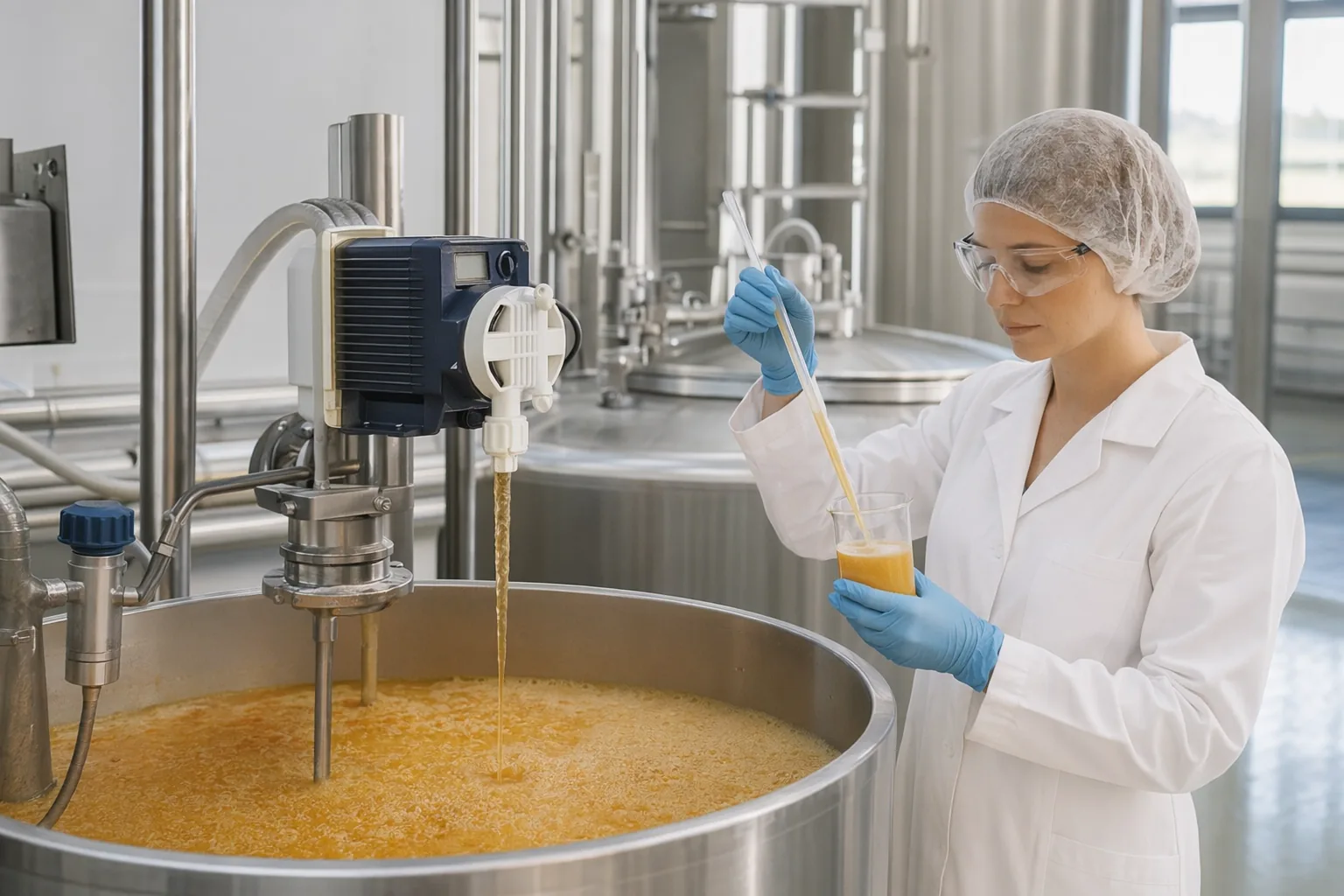
For juice, wine and textile retting plants, choosing a pectinase concentrate is a cost-in-use decision, not a price-per-kilogram purchase.
Our concentrate is produced from Aspergillus niger and combines polygalacturonase (EC 3.2.1.15) and pectin lyase (EC 4.2.2.10) activities. It is supplied as a dark brown liquid or a tan powder at 100,000–500,000 PGAU/g, in 1 kg, 5 kg, 25 kg and 200 L packs, with a minimum order of 1 kg.
Processors and distributors can request a quote: send the product (liquid or powder, activity grade), quantity, pack size and destination.
What Industrial Buyers Need from a Pectinase Concentrate
Buyers need a concentrate with defined pectinase activity, stable handling properties and technical support for plant validation. In fruit processing, pectinase breaks down soluble and insoluble pectin, lowering mash viscosity and improving juice release, clarification, pressing and filtration. In wine, it supports maceration and settling when matched to grape variety and process goals. In textile retting, selected pectinase systems help remove pectic substances from bast fibers under controlled conditions.
The most useful supplier conversation starts with substrate type, solids level, pH, temperature, contact time, the result you need and any processing aids already used. A qualified supplier turns these inputs into dosage trials, analytical checks and documentation, rather than recommending a fixed dose without context.
Typical applications: juice extraction, wine processing, and textile retting • Performance depends on substrate pectin structure, process pH, temperature, and residence time
Process Fit for Juice and Wine
Our concentrate works at pH 3.0–5.0 and 40°C–55°C, which fits many acidic fruit and wine systems. Add it where mixing is effective and before the pressing or settling steps where lower viscosity creates value. Contact time and dose are set by substrate load, turbidity targets and tank logistics, and confirmed in trials. Wine trials should consider grape variety, skin contact objectives, phenolic extraction and sulfur dioxide program compatibility.
Screen at actual plant pH, not only in buffer • Confirm the activity window from the product documents • Avoid excessive heat before the intended reaction time is complete • Track yield, turbidity, viscosity, and filtration rate
Dose and Cost-in-Use
The lowest quoted price is rarely the best measure of pectinase value. Cost-in-use compares enzyme cost against juice yield increase, press capacity, clarification time, filter aid consumption, energy use, rework, and waste disposal. A concentrated pectinase may cost more per kilogram but less per ton of fruit if activity, stability, and mixing behavior are stronger. When planning a trial, run a dose-response curve rather than a single trial. Include an untreated control, a current-process benchmark, and at least three dosage levels under the same temperature and residence time. For enzyme pectinase fruit juice production, record both analytical data and operator observations, such as ease of pumping, cake dryness, foaming tendency, and settling behavior. The best operating dose is usually where incremental yield or throughput improvement begins to plateau, while quality remains within specification.
Calculate cost per metric ton of substrate treated • Compare yield gain and press cycle reduction • Measure filtration throughput and filter media consumption • Include labor, downtime, and waste handling in the model
How to Specify It for Purchasing
A strong purchasing specification should define more than the word pectinase. Ask the supplier for a current Technical Data Sheet, Certificate of Analysis, and Safety Data Sheet for the exact commercial grade. The TDS should describe activity type, recommended pH and temperature, dosage guidance, appearance, solubility, storage, and shelf life. The COA should identify batch number, activity assay result, physical parameters, and relevant quality checks. The SDS should support safe handling, storage, spill response, and transport classification. For pectinase juice applications, also request information on carrier system, preservatives if used, allergen or food-contact statements where applicable, and compatibility with downstream fining, filtration, or concentration steps. If your team compares pectin vs pectinase, specify that pectin is the substrate and pectinase is the enzyme that degrades it.
Request COA, TDS, and SDS before approval • Confirm activity assay and unit definition • Check shelf life and storage temperature • Match grade selection to juice process conditions
QC Checks and Lot Release
A reliable supply should provide batch documentation and practical QC guidance. Buyers should request a COA showing lot number, activity result, test method reference, appearance, pH or density where applicable, microbiological limits for food applications, and shelf-life information. The TDS should define recommended pH and temperature ranges, storage conditions, dilution guidance, and application notes. The SDS should support safe handling, spill response, PPE selection, and transport review. Internal QC can include viscosity reduction tests on standard pectin solution or real fruit mash, turbidity or NTU tracking after clarification, soluble solids checks, pH confirmation, sensory review where relevant, and residual activity or heat inactivation verification. For production-scale release, compare new lots against a retained reference or approved lot under the same laboratory method.
Review COA, TDS, and SDS before purchase approval • Confirm activity method and unit definition • Check storage temperature and shelf-life requirements • Use lot comparison testing for critical processes
Supplier Qualification and Regional Sourcing
Supplier qualification should combine technical, quality, commercial, and logistics review. For pectinase concentrate, ask whether the supplier can provide consistent activity, stable lead times, clear documentation, and responsive application support. Request the current specification, COA examples, TDS, SDS, allergen or food-contact statements where applicable, packaging options, minimum order quantity, recommended storage, and retest policy. If your facility requires specific quality-system evidence, request current documents and verify they apply to the production site and material supplied; do not assume certifications that are not documented. Commercial review should include Incoterms, batch reservation, change notification, shelf-life on delivery, and complaint handling. For strategic supply, qualify a second lot or backup supply route. The strongest pectinase supplier relationship is one where procurement, QA, R&D, and production all see the same validated performance data.
For buyers importing into the UK, India, South America or other regions, import documentation, local regulations, ambient shipping conditions and warehouse temperature control can affect total supply reliability. Ask for representative samples from a defined batch, not only a brochure, and run pilot validation before plant-scale dosing.
Request documented specifications and change-control expectations • Verify shelf life remaining at delivery • Assess technical response time during trials • Confirm packaging fits plant dosing and storage systems
Technical Buying Checklist
Product: liquid or powder, and activity grade (100,000 or 500,000 PGAU/g) • Pack size: 1 kg, 5 kg, 25 kg or 200 L • Documents for approval: COA, TDS and SDS • Substrate, process step and target result • Quantity, delivery schedule and destination
Request a Quote
Juice, wine and fruit processors, contract manufacturers and distributors can request a quote by email or through the inquiry form. Send the product (liquid or powder, activity grade), quantity, pack size and destination, plus your substrate and process step. Pricing is quoted per order. Free sample included with every qualified inquiry.
Pectinase (Concentrate) for Research & Industry
Need Pectinase (Concentrate) for your lab or production process?
ISO 9001 certified · Food-grade & research-grade · Ships to 80+ countries
Frequently Asked Questions
What is the main advantage of using pectinase in fruit juice production?
The main advantage is improved processing efficiency. Pectinase reduces pectin-related viscosity, helping fruit mash release more juice and improving pressing, settling, clarification, and filtration. The value depends on the fruit, enzyme activity, dose, pH, temperature, and contact time. Buyers should quantify the advantage by comparing yield, turbidity, filtration rate, processing time, and total cost-in-use against an untreated control.
How should we choose a dosage for industrial pectinase production use?
Do not select dosage from a brochure alone. Start with a supplier-recommended screening range, then run a dose-response trial using your actual fruit, mash solids, pH, temperature, and residence time. Include a control and current benchmark. Measure yield, viscosity, turbidity, filtration speed, and quality. The preferred dose is usually the point where further addition brings little extra economic or process benefit.
Which documents should a pectinase concentrate supplier provide?
A qualified supplier should provide a COA for the batch, a TDS with activity range and application guidance, and an SDS for safe handling. Buyers may also request specification sheets, activity test method information, shelf-life and storage guidance, packaging details, allergen or food-use statements where applicable, and change notification expectations. These documents support QA approval, pilot validation, and purchasing control.
Can the same pectinase be used for juice, wine, and textile retting?
Sometimes, but it should not be assumed. Juice and wine often require acidic pectinase performance, while textile retting may need different pH tolerance, side activity control, and fiber-protection validation. The correct enzyme depends on substrate, process water, temperature, residence time, and quality target. Ask the supplier to recommend the activity profile and confirm performance through application-specific pilot trials before routine production.
How do we qualify a new pectinase enzyme supplier?
Qualify the supplier through documentation review, laboratory screening, pilot trials, and commercial risk assessment. Review COA, TDS, SDS, specifications, shelf-life policy, packaging, and change-control process. Test at least one production-representative lot against your current benchmark. Confirm technical support, lead time, complaint handling, and batch consistency. Final approval should be based on validated performance, not only quoted price.
How is pectin different from pectinase?
Pectin is a natural polysaccharide in fruit cell walls that can make mash thick, cloudy, and harder to press or filter. Pectinase is the enzyme system used to degrade pectin into smaller fragments. In simple pectin vs pectinase terms, pectin is the material causing viscosity and haze challenges, while pectinase is the processing tool used to manage those challenges.
Request Documents and a Trial Plan
Request Pectinase Concentrate COA/TDS/SDS and a pilot trial plan for your production line. Request a pectinase concentrate sample, COA, TDS, SDS, and pilot trial guidance for your juice line.
Contact Us to Contributehello@mail.topenzyme.com