Liquid or Powder: Choosing a Pectinase Concentrate Format for Juice and Wine Lines
Compare the liquid and powder forms of our pectin-degrading concentrate: dosing, storage, shelf life, packs, documents and pilot validation, then request a quote.
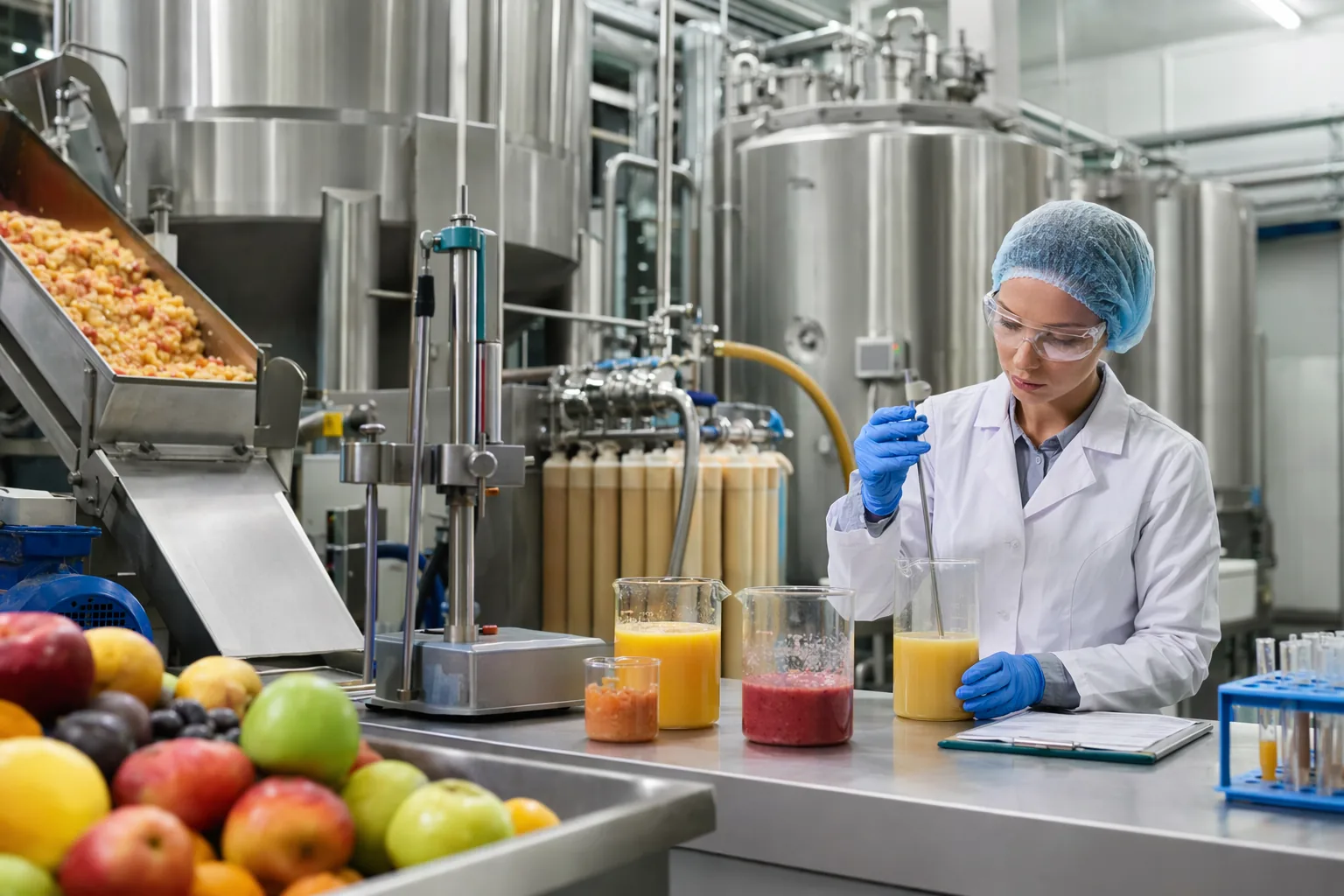
The enzyme format decides how a juice or wine plant doses it, stores it and plans inventory. Choosing liquid or powder is a process and logistics decision as much as a technical one.
Our concentrate comes in both forms with the same working range, pH 3.0–5.0 and 40°C–55°C, at 100,000–500,000 PGAU/g. The liquid is dark brown and keeps 12 months refrigerated; the powder is tan and keeps 24 months. Packs are 1 kg, 5 kg, 25 kg and 200 L, with a minimum order of 1 kg.
Plants and distributors can request a quote: send the product (liquid or powder, activity grade), quantity, pack size and destination.
Why the Format Matters for a Juice Plant
For industrial juice extraction, the enzyme is not a commodity when the process depends on yield, press throughput, viscosity reduction and stable clarification. Apple, berry, grape, citrus and tropical fruit mashes contain different pectin structures, soluble solids and acidity, so the same enzyme can perform differently across lines. Evaluate the format against your mash holding time, dosing equipment, heating profile, storage and downstream filtration system.
Prioritize performance in your fruit mash over generic activity claims. • Confirm whether the product targets extraction, clarification, or both. • Ask how activity is measured and reported. • Match enzyme format, packaging, and storage to plant handling practices.
Liquid vs Powder at a Glance
Liquid suits inline dosing and requires refrigeration (12-month shelf life). Powder offers 24-month shelf life and is ideal for dry dosing or long-term storage. Both forms share the same working range and activity grades, so the choice rests on your dosing system, storage conditions and how quickly you use a pack.
Liquid: dark brown, inline dosing, refrigerated, 12 months • Powder: tan, dry dosing, cool and dry storage, 24 months • Both: pH 3.0–5.0, 40°C–55°C, 100,000–500,000 PGAU/g • Packs: 1 kg, 5 kg, 25 kg, 200 L
Process Window and Dosing
Most juice extraction applications use pectinase in acidic conditions; our concentrate works at pH 3.0–5.0 and 40°C–55°C. The dose is established by trial, starting from the activity on the product documents, then refined by fruit pectin load and contact time. A higher label activity does not automatically mean a lower cost-in-use, because solubility, side activities, stability and plant conditions change real performance.
Screen several dosages before selecting the commercial addition rate. • Record mash pH, temperature, Brix, viscosity, and treatment time. • Avoid excessive heat exposure before the enzyme has completed its function. • Verify compatibility with preservatives or processing aids used onsite.
Pectin vs pectinase: what the specification should clarify
In a purchasing discussion, pectin vs pectinase should be clearly understood. Pectin is a structural polysaccharide found in plant cell walls and middle lamella; it can increase mash viscosity and hold juice inside fruit tissue. Pectinase is the enzyme system that hydrolyzes pectin, helping release juice, reduce viscosity, and improve separation. A commercial pectinase concentrate may contain polygalacturonase as a key activity, and it may also include pectin lyase, pectin methylesterase, hemicellulase, or cellulase side activities depending on formulation. The technical data sheet should identify the declared activity, test method basis, carrier system, moisture limits, recommended use range, and storage conditions. For juice extraction, ask whether the preparation is optimized for mash maceration, depectinization, clarification, or multi-purpose fruit processing, because the best enzyme balance can differ.
Pectin is the substrate; pectinase is the catalytic tool. • Polygalacturonase activity is important but not the only comparison point. • Side activities can help extraction but should be suitable for the juice style. • A TDS should define recommended pH, temperature, dosage, and handling.
Pilot validation before commercial purchase
Before committing to regular supply, run a pilot validation using representative fruit, normal seasonal variability, and the same equipment logic used in production. A useful trial compares the incumbent pectinase, one or more alternatives, and an untreated control under identical pH, temperature, dosage, and time. Key outputs include free-run juice yield, press cake moisture, viscosity, turbidity, filtration rate, settling speed, color, aroma, and final soluble solids. For cloudy juice, the target may be improved extraction without over-clarification; for clear juice, the target may include faster depectinization and lower filter load. Keep samples for stability observation and conduct sensory checks to confirm the enzyme does not create unwanted changes. The strongest supplier will help design the pilot, interpret results, and translate trial dosage into commercial cost-in-use.
Use untreated, incumbent, and candidate enzyme comparisons. • Measure yield, viscosity, turbidity, filtration, and press performance. • Validate both technical performance and sensory acceptability. • Convert pilot dosage into cost per metric ton of fruit processed.
Supplier Qualification for Regional and Export Buying
Supplier qualification should cover documentation, manufacturing consistency, logistics, and responsiveness. Request a recent COA for the offered batch, a TDS for application guidance, and an SDS for safe storage and handling. Whether you buy from a local distributor or an export supplier, check lead time, shelf life remaining on arrival, minimum order quantity, packaging integrity, and temperature exposure during transport, which matters most for the refrigerated liquid. Ask how activity is controlled between batches and whether retained samples are available for investigation if performance changes. For companies that also use pectinase in wine or textile retting, confirm that the product grade and documentation match the intended application.
Request COA, TDS, SDS, shelf-life data, and storage instructions. • Check batch traceability and activity consistency procedures. • Confirm packaging sizes suit dosing accuracy and warehouse conditions. • Assess technical response time, not only quoted price.
Technical Buying Checklist
Format: liquid or powder • Activity grade: 100,000 or 500,000 PGAU/g • Pack size: 1 kg, 5 kg, 25 kg or 200 L • Storage on site: refrigerated space for liquid, cool dry store for powder • Documents: COA, TDS and SDS • Quantity and destination
Request a Quote
Juice and wine producers, fruit processors and distributors can request a quote by email or through the inquiry form. Send the product (liquid or powder, activity grade), quantity, pack size and destination. Pricing is quoted per order. Free sample included with every qualified inquiry.
Pectinase (Concentrate) for Research & Industry
Need Pectinase (Concentrate) for your lab or production process?
ISO 9001 certified · Food-grade & research-grade · Ships to 80+ countries
Frequently Asked Questions
What is pectinase in industrial juice extraction?
Pectinase is an enzyme system used to hydrolyze pectin in fruit mash or juice. In industrial extraction, it can help release juice from plant tissue, reduce viscosity, improve pressing, and support clarification or filtration. Commercial pectinase enzyme powder may contain several enzyme activities, so buyers should match the activity profile to the fruit type and the desired process outcome.
How should we choose between liquid and powder forms?
Liquid suits inline dosing and requires refrigeration (12-month shelf life). Powder offers 24-month shelf life and is ideal for dry dosing or long-term storage.
How should we compare pectinase powder suppliers?
Compare suppliers by verified activity data, recommended pH and temperature range, dosage guidance, solubility, packaging, shelf life, and documentation quality. Always request COA, TDS, and SDS before ordering. The best comparison includes pilot trials using your own fruit, equipment conditions, and quality targets, followed by a cost-in-use calculation per metric ton of fruit processed.
What dosage of pectinase enzyme powder is typical for juice?
Dosage depends on enzyme concentration, fruit pectin content, mash pH, treatment temperature, and contact time. Start from the activity on the product documents, then narrow the dose through pilot trials. The final commercial dosage should be based on yield, viscosity reduction, filtration rate, and sensory results.
What is the difference between pectin and pectinase?
Pectin is a plant polysaccharide that can increase viscosity and hold juice inside fruit tissue. Pectinase is the enzyme preparation used to break down pectin. In juice extraction, this difference matters because the buyer is not purchasing pectin; the buyer is selecting a pectinase enzyme that can act efficiently on the pectin structure present in the target fruit.
Why does cost-in-use matter more than price per kilogram?
Price per kilogram can be misleading because a lower-priced powder may require higher dosage, longer treatment time, or create slower filtration. Cost-in-use considers enzyme activity, effective dose, yield improvement, throughput, waste reduction, and batch consistency. For B2B purchasing, the most useful figure is often cost per metric ton of fruit processed at validated production conditions.
Request a Format and Dosing Review
Request a pectinase powder specification review, sample, and pilot-trial dosage recommendation for your juice line.
Contact Us to Contributehello@mail.topenzyme.com